


Every Size, Not Just Large Exporters
A small exporter shipping its first container needs a verifiable identity as much as a multinational trading house. Traders of every size are in scope.

Select Your Jurisdiction
Currently selected: Singapore|

Search region…
Global supply chains run on trust between parties that have often never met, and every regional registry, local identifier and manual KYC check adds friction, cost and fraud risk to that trust. The LEI replaces the patchwork with one globally verifiable identifier, recognized the same way whether a trading partner is a supplier, freight forwarder, bank or buyer. LEI System registers and manages LEI codes for trading entities and their full partner network, backed by GLEIF accreditation and a 150-jurisdiction reach.


LEI System is an official LEI Registration Agent
Latest LEIs issued:
984500F4100AB5956011 |  QUINNCOM INTERNATIONAL PTY LTD
The requirement reaches every entity in a trading relationship, and
relevance has nothing to do with company size.
A small exporter shipping its first container needs a verifiable identity as much as a multinational trading house. Traders of every size are in scope.
Companies trading across borders use the LEI to identify themselves to buyers, suppliers, banks and customs, instead of local IDs that don't translate abroad.
Banks and financiers providing letters of credit, invoice finance or trade guarantees use the LEI to verify the entities on both sides of a financed transaction.
Logistics companies coordinating multi-party shipments use the LEI to identify each party in the chain consistently across the documents and systems the shipment passes through.
Corporate procurement and supply chain functions use LEI reference data to verify new suppliers during onboarding, replacing manual registry checks with an instant lookup.
Fragmented identification is the reason to register. These are the operational problems it solves along the way.
| Problem | How the LEI Solves It |
|---|---|
| Every region uses a different local identifier for the same trading partner | One LEI resolves to one verified entity record, recognized the same way everywhere |
| Manual KYS checks slow down new supplier onboarding | One LEI lookup returns verified legal name, address and status instantly |
| Fraudulent or shell counterparties are hard to catch before a deal is signed | LEI Level 2 ownership data surfaces the real structure behind a trading partner |
| Verifying a foreign trading partner's legal status takes days of registry work | GLEIF's public index resolves a partner's identity in seconds, no matter the jurisdiction |
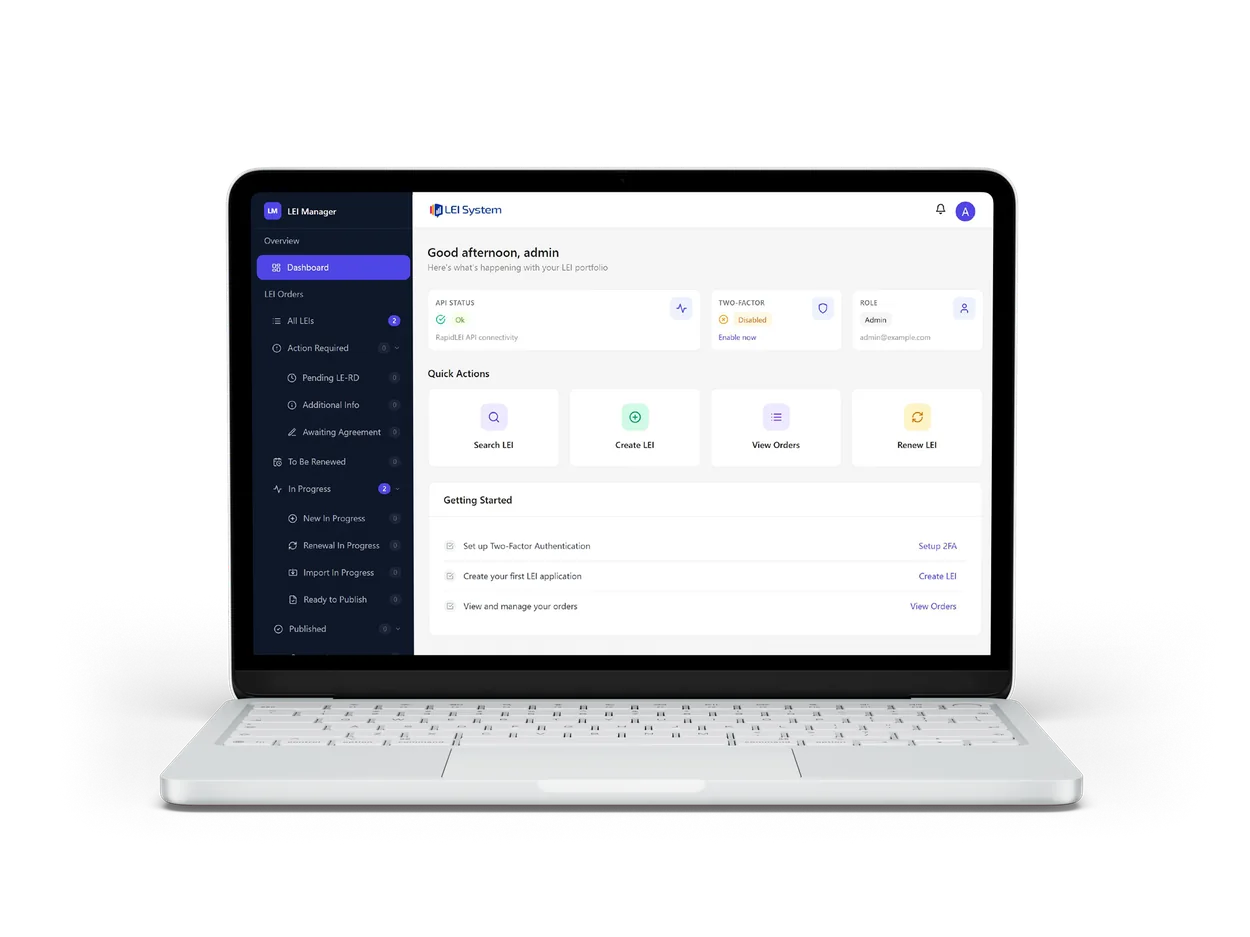
| Tracking LEIs across dozens of suppliers and partners doesn't scale on spreadsheets | LEI Manager's dashboard tracks every partner's code status and renewal in one place |
Beyond satisfying due diligence, this is where the LEI actually gets used day to day.
Look up a prospective supplier's LEI to confirm legal name, registered address and status before onboarding them into a procurement system.
Include LEI codes for both parties in a letter of credit or trade finance application, giving the financing bank a verified identity for each side of the transaction.
Reference an exporter or importer's LEI in a digitized bill of lading, linking the document to a verifiable global entity record rather than a free-text company name.
Confirm a foreign trading partner's legal status and jurisdiction through its LEI record before committing to a purchase order or shipment.
Identify shipper, consignee and freight forwarder consistently across a multi-party shipment using LEI codes rather than each party's own internal reference.
International trade has never had a single, universally recognized way to identify a company, every jurisdiction runs its own business registry, using its own numbering system, in its own language.
That fragmentation is exactly what the LEI was built to solve: a standards effort backed by the G20 and the international standards community settled on one machine-readable identifier that resolves to authoritative registry data anywhere in the world, replacing a patchwork of local registration numbers with a single, mutually recognized one.
Due diligence is the reason trading companies register an LEI. What it changes operationally is the reason it's worth doing properly.
Due diligence is the reason trading companies register an LEI. What it changes operationally is the reason it's worth doing properly.
Capturing a new supplier's LEI at onboarding pulls verified identity data from GLEIF automatically, cutting the manual registry-checking work a procurement team would otherwise do by hand.
Electronic trade documents, including e-bills of lading under frameworks like the UK's Electronic Trade Documents Act, need a reliable identity anchor for each party; the LEI is built to be exactly that.
LEI Level 2 ownership data shows who actually stands behind a trading partner, surfacing red flags a name-only check would miss entirely.
A partner's LEI record resolves their legal status and jurisdiction in seconds through GLEIF's public index, instead of a manual search across an unfamiliar national registry.
Trade identification isn't governed by a single regulation the way securities reporting is, but several converging frameworks make verified entity identity increasingly the default expectation.
The G20's roadmap for faster, cheaper cross-border payments names broader LEI adoption as one of its concrete building blocks, directly relevant to trade-linked payment flows.
FATF's standards on transparency of legal arrangements push trade and trade-finance participants toward verifiable ownership data, exactly what LEI Level 2 records provide.
Laws like the UK's Electronic Trade Documents Act enable digital bills of lading and similar instruments, which need a consistent, verifiable party identifier, the role the LEI is positioned to fill.
| Framework | Scope | Relevance to Trade |
|---|---|---|
| G20 Cross-Border Payments Roadmap | Global | Names LEI adoption as a building block for faster cross-border payments |
| FATF Beneficial Ownership Standards | Global | Pushes verifiable ownership data for trade and trade-finance counterparties |
| Electronic Trade Documents Act (UK) | UK | Enables digital trade documents needing a consistent party identifier |
Individual registration works when you need one LEI. Trading companies rarely stop at one, supplier networks, freight partners and subsidiary entities all need identifiers tracked at once.
LEI Manager is LEI System's platform for exactly that.
Explore LEI ManagerTrack every LEI you're responsible for, your own entity, key suppliers, trading partners, from one dashboard, with automatic renewal so a partner's code never lapses mid-relationship.
Connect LEI lookup and status checks directly into supplier onboarding or trade-documentation systems via the LEI Manager API, so counterparty verification happens automatically.
Register up to 200 supplier or partner entities in a single upload instead of repeating the application 200 times, LEI Manager verifies each one against official registries and issues codes without separate validation delays.
Getting registered is a five-minute online process, not a paperwork exercise. Submit your entity's legal name and registration details, LEI System verifies them against official business registries, and your code is issued and published to the GLEIF Global LEI Index, immediately checkable by any counterparty or regulator who looks it up.

Pick a subscription plan and complete the online application with your entity's legal name, address and registration number.


Our system verifies your entity data against official business registries in real time, notifying if additional documents are needed.

Your LEI code is issued, recorded in the Global LEI Index and delivered to your email address along with a confirmation.
Every LEI System plan includes the GLEIF fee, lapse protection, and automatic annual renewal, so a code stays in ISSUED status for every transaction it is used in, not just the first one.

Kristian Hein, November 23
Europe is moving towards common standards for tokenised securities as digital technologies reshape capital markets. The new European Tokenisation Standards Group will focus on connecting financial systems and building on established industry standards. This article explores how the Legal Entity Identifier (LEI) and its digital counterpart, vLEI, support trusted identification, automated verification and interoperability across the next generation of financial markets.
Read more
Kristian Hein, November 18
The Financial Stability Board’s 2026 cross-border payments report highlights the UK’s CHAPS system as a live example of how Legal Entity Identifiers are moving into payment infrastructure. CHAPS handles everything from time-sensitive business and property payments to large financial-market settlements. Its financial-institution layer carries 73% of the value settled, making LEI data especially relevant for risk management, compliance, counterparty identification, and automated processing.
Read more
Kristian Hein, November 11
Does a branch need its own LEI, or should it use the head office’s code? Opening a foreign branch does not automatically create a separate LEI requirement. This guide explains the difference between branches and subsidiaries, when reporting rules call for the head office’s LEI, and when a branch may need its own. Find out what to check with your bank, broker or supervisory authority before applying.
Read more






 Affordable
 Lapse Guard
 Auto Renewals
 $99 total